
Contributed by Vimari Román, CMM, PCC, CPQC
During my keynote at the Next-Gen Experience Summit, I opened with a simple prompt:
“Think about the best event you have ever attended — not necessarily the one with the biggest keynote, the most impressive venue, or the best production. Think about the one that stayed with you.”

Then I asked attendees to raise their hands if they could remember the event’s exact agenda.
Not one hand went up.
That’s when I realized we may be measuring the wrong things.
What they remembered were the moments: an unexpected insight, a meaningful conversation, the feeling of being welcomed, or the sense that their presence mattered.
That response reinforced something I have come to believe after more than two decades in hospitality, meeting management, facilitation, coaching, and teaching future event professionals at Florida Atlantic University:
People do not experience agendas. They experience moments.
As event professionals, we invest enormous time and energy into schedules, speakers, venues, food and beverage, production, technology, and operational details. All of those elements are important and matter. They provide the structure that makes an event possible.
But the agenda creates the schedule. People create the experience.
That distinction is becoming increasingly important as we prepare for Gen Z, Gen Alpha, and the generations that will follow. It is tempting to approach the future of meetings by asking what each generation wants and then developing different solutions for different age groups.
I believe there is a more meaningful question:
What if the future of meetings is not primarily generational, but behavioral?
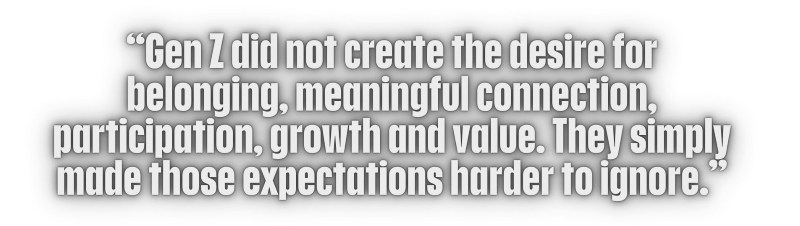
Gen Z did not create the desire for belonging, meaningful connection, participation, growth, and value. They simply made those expectations harder to ignore.
Seasoned professionals want many of the same things. They may express their expectations differently, but no attendee wants to feel invisible, disconnected, overwhelmed, or unsure whether an event was worth the investment.
 The future of event design is not about abandoning logistics. It is about designing beyond them.
This thinking led me to create the Beyond the Agenda H.E.A.R.T. Framework™, a behavior-driven approach that helps planners consider the human experience behind every agenda decision.
H.E.A.R.T. challenges us to think about whether our events help people belong, enable meaningful connection, amplify every voice, reveal new possibilities, and transform attendees’ time into genuine value.
The framework is not about adding more activities to an already crowded schedule. It is about asking better questions about the moments that are already there.
Consider a traditional networking reception. We place hundreds of people in a ballroom with food, beverages, music, and high-top tables, and we assume we have created networking.
Yet people who already know one another frequently stay together. Extroverts comfortably work the room, while first-time attendees, introverts, or those arriving alone may remain on the edges.
We have created proximity, but not necessarily connection.
The answer is not always another activity, vendor, or line item in the budget. It may be as simple as offering a meaningful conversation prompt, assigning table hosts who make introductions, or inviting each attendee to meet one person whose experience could help with a current challenge.
The ballroom, timing, and budget may remain the same. What changes is the intention—and the behavior the environment supports.
I saw the power of this approach immediately after my keynote. During lunch, the summit organizers implemented a facilitated “Fun Facts” question inspired by the session. It was a small adjustment, but it changed the energy at the tables, encouraged participation, and helped attendees learn something memorable about one another.
The idea moved from the stage to the attendee experience within minutes.
That is the opportunity in front of us.
Before you finalize your next agenda, select one moment and ask:
What do I want attendees to experience here and what conditions am I creating to make that possible?
That question may change how you welcome first-time attendees, facilitate a general session, structure a meal, design networking, or conclude the event.
The events that shape the future will not necessarily be the ones with the most content, technology, or elaborate production. They will be the ones designed by professionals who understand human behavior and intentionally create the conditions for meaningful experiences to happen.
Great agendas organize time. Great planners design what people will remember.