
By Heather Pilcher, CSEP, CMP, CEO
Artificial intelligence has quickly become a central topic across nearly every industry, and the events world is no exception. In my role as CEO and executive producer at Blue Spark Event Design, I have had a front row seat to how AI has evolved from a novelty into a practical tool for planners. At the same time, its rapid adoption has introduced new challenges, particularly in how clients interpret what they see and what they expect to be possible in a live, temporary environment.

Generative AI, especially image generation, has proven to be an incredibly useful resource when it comes to communicating creative concepts. In the past, helping clients visualize an idea often required extensive back and forth, multiple revisions, and detailed explanations that still left room for misinterpretation.
Today, with publicly available images of venues and a few well chosen prompts, we can generate immersive visual scenes that show clients how a concept could look in real time. This has streamlined early conversations and allowed clients to feel more confident and excited about a direction much faster than before.
However, these same tools can also create friction when the images suggest outcomes that are not physically achievable. AI has no inherent understanding of power requirements, scale, safety considerations, or the basic laws of physics. It will happily generate a wall of fire or a floating installation without acknowledging event insurance policies, fire codes, or gravity. This often places planners in the position of needing to recalibrate expectations after a client has already emotionally bought into an image.
Another common disconnect comes from the realities of temporary event production. Unlike permanent architectural installations, events are built and dismantled within very tight windows, often in as little as four hours. Materials must fit through freight elevators, loading docks, and narrow access points.
Custom builds that need to support weight or use dense materials may be viable in a fixed structure but are impractical or unsafe for a one night event. AI generated images rarely account for these logistical constraints, which can make even well intentioned concepts unrealistic once production details are considered.
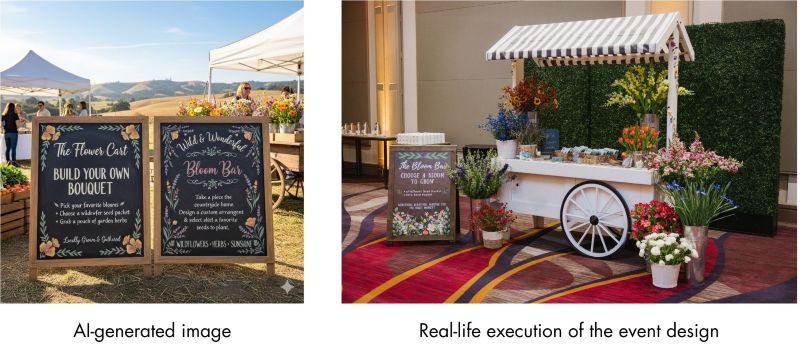 AI image generators are also not immune to hallucinations. We have encountered floral designs rendered in colors so saturated they do not exist in nature, structural builds that pass straight through venue walls, and elaborate water features with no visible plumbing or water source. While these images may be visually compelling, they often omit the functional systems that make real world execution possible.
It is also important to note that this issue did not begin with AI. Clients have always been shown idealized versions of products and services. Vendors naturally present their work in the best lighting, from the best angles, and under perfect conditions. This has long been a source of occasional disappointment when expectations meet reality. AI image generation has simply accelerated and intensified this dynamic by making hyper idealized visuals faster and easier to produce.
AI can be an extremely powerful and valuable tool for event professionals when used responsibly. The key lies in clear and upfront communication. Clients need to understand when AI has been used to generate imagery and how those visuals may differ from what can be safely and realistically produced. When framed properly, AI becomes a collaborative starting point rather than a fixed promise, allowing creativity to flourish while still respecting the practical limits of live events.
As the CEO and Executive Producer of Blue Spark Event Design, Heather Pilcher, CMP, CSEP, is widely recognized for her innovative, brand-forward approach to corporate event planning. With more than 24 years of experience producing events for audiences ranging from 50 to 200,000 attendees, Heather has built a business model that elevates customer service while designing immersive, emotional events around the world—from promotional activations to corporate conferences and incentive celebrations.You May Also Be Interested In…
AMEX GBT Reports Strong Q4 Results
5 Trends Shaping Meetings in 2026
Event Trends for 2026: Technology Meets Connection