

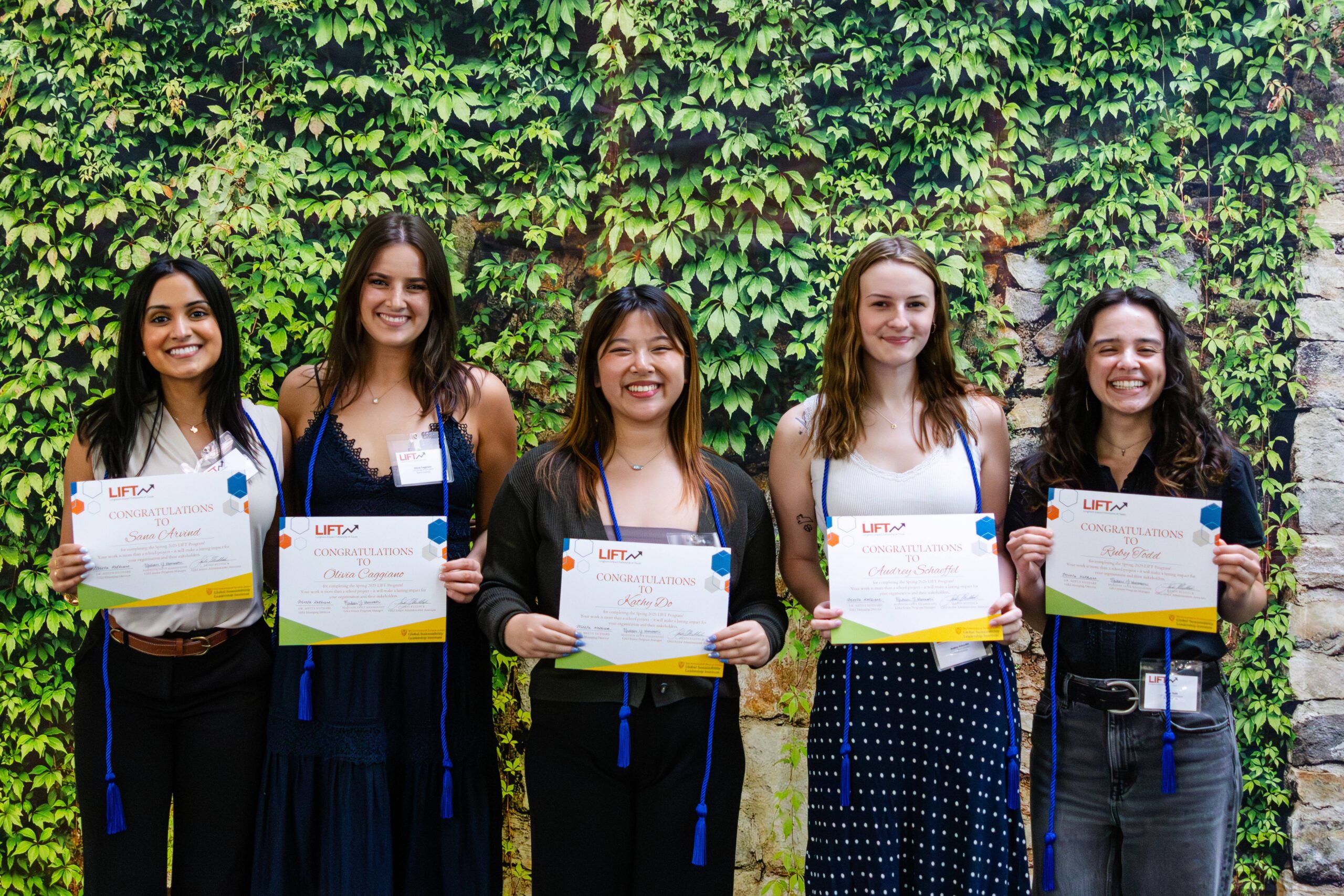

Maritz partnered with a group of students at the University of Texas at Austin to find more sustainable solutions for common event materials.
The biggest opportunities in event sustainability often lie in the most overlooked places: the carpet underfoot, the badge around your neck and the sign pointing you toward Ballroom B.
That’s the premise behind a new collaboration between Maritz and the University of Texas at Austin’s McCombs School of Business through its Longhorn Impact Fellowship at Texas (LIFT), a program of the Global Sustainability Leadership Institute. The goal was straightforward but ambitious: Quantify the carbon footprint of common event materials and identify better options.

“We’ve always wanted to know this,” said Rachael Riggs, General Manager of Environmental Strategy at Maritz. An alumni connection opened the door to the student-led consulting program, where graduate students take on live business challenges. “I gave them the four pieces we wanted to run the carbon emissions on,” Riggs said. “Of the most-used products, what’s the baseline — and what should we be using instead?”
Four Materials, Big Impact
The students focused on four ubiquitous items: carpeting, signage, lanyards and name badges. Using interviews with industry suppliers and carbon accounting methodologies aligned with the Greenhouse Gas Protocol, they built emissions profiles and evaluated alternatives.
Carpeting: Traditional synthetic carpet used at large trade shows can emit up to 7.2 kilograms of CO₂ equivalent per square meter. Given that major exhibitions install tens of thousands of square feet, the impact is exponential. The students found that recyclable and closed-loop systems, such as those offered by suppliers like Rewind and Emerald, can reduce emissions by more than 80%, particularly when end-of-life recovery is built into the supply chain.
“The key insight was to focus less on the fiber and more on what happens at the end of its life,” Riggs said. “It’s all about your supply chain.”
Signage: Industry signage staples foam core and PVC vinyl are both high-emission and difficult to recycle. Alternatives such as eco-board and polypropylene-based materials offer lower emissions and improved recyclability. The team’s top recommendation, however, was to go digital wherever possible. When you just have to use printed materials for signage, printed sticks, or even glossy paper handouts, FSC-certified paper can significantly reduce environmental impact.
For many planners, these swaps may sound incremental. But as Riggs noted, “If we do a few things well to change the industry’s thinking, what’s that exponential impact?”
Badges: PVC badges — widely used for durability and branding — can emit up to 1.51 kilograms of CO₂ equivalent each. Cork badges, by contrast, are carbon-negative due to cork’s natural carbon sequestration properties. Recycled cardboard options offer a low-cost, low-emission alternative that is easy to source and widely recyclable.
Lanyards generated similar findings. Polyester ranked highest in emissions, while recycled PET, bamboo and hemp offered significantly lower footprints. But material substitution was only part of the equation. The students recommended collection bins and structured reuse programs — small operational shifts that can significantly reduce waste over time.
Riggs adds that the research continues to affect how she sees events. After attending a recent trade show, she found herself fixated on the metal clips attached to thousands of lanyards. “If we eliminate metal in a name badge, that could be huge,” she said. “It’s the baby steps that can really add up.”
Cost was not the central driver of the research, but students incorporated price considerations into their final recommendations. They found that in many cases, better environmental choices are competitively priced — especially when planners rethink budgets holistically. Savings from digital signage, for example, can offset investments in more sustainable print materials.
A Model for Industry Transformation

The partnership reflects a broader strategy at Maritz to leverage academic collaboration as a catalyst for innovation. Riggs described the student selection process as akin to hiring a consulting team, with MBAs and undergraduates bringing diverse perspectives from companies such as Dell and Nike.
“They were curious, data-driven and eager to make a difference,” she said. “It was really cool to see that passion.”
For an industry that spans convention centers, general service contractors, sponsors and exhibitors, sustainability progress can feel uneven. Riggs believes education is key.
“As we go forward, supply chain is language that’s talked about every day in the sustainability industry,” she said. “In the events industry, it’s not — and it needs to be.”
By grounding sustainability conversations in data — and focusing on the everyday materials that define the event experience — the Maritz–UT Austin collaboration offers a practical roadmap. The carpet, the sign, the badge and the lanyard may seem like small details. But multiplied across thousands of events, they represent one of the industry’s opportunities for measurable change.
You May Also Be Interested In…
GBTA Foundation Honored for Advancing Sustainable Procurement
Sustainable Business Travel: Bright Spots and Bottlenecks
Waste Not, Want Not: Avoiding Food Waste at Events