


Why purpose-built, activity-anchored venues are increasingly showing up on meeting planners’ venue shortlists.
Mini-golf leaderboards. Bowling lanes lined with craft cocktails. A 180,000-square-foot rec complex with turf fields and a double-decker laser tag arena. It’s not your imagination — purpose-built, activity-anchored venues are increasingly showing up on meeting planners’ shortlists alongside hotels, conference centers and traditional event spaces. These so-called “eatertainment” venues are reshaping how — and where — companies gather.
So what exactly is eatertainment? It’s what’s happening in venues that pair an interactive activity (bowling, mini-golf, axe throwing, pickleball or arcade gaming, to name a few examples) with a serious food-and-beverage program.

Another key ingredient is that the venues are designed to be enable guests to move around freely rather than be seated in formal dining areas and easily share what’s happening on their socials. A time-honored version of this is bowling-anchored concepts, which remain the largest subcategory by venue count. But now planners are seeing operators that are increasingly layering in other activities, such as shuffleboard, karaoke and bocce, to build multi-activity destinations rather than single-activity ones.
The concept is a winner for many corporate groups who are looking for an easy win: One venue, one contract, and no need to coordinate a caterer, an activity vendor and a space rental separately.
Why is this trending now? On a corporate level, the return-to-office (RTO)-era, combined with a competitive labor market, makes being able to offer this type of in-person gathering an example to show how they treat employees. There’s also a broader shift away from single mega-conferences toward smaller regional meetings, with some companies reporting higher satisfaction and stronger post-event collaboration from smaller-format gatherings than from large national ones — just the sort of gatherings these venues can accommodate.
On the planner level, there’s been a growing swell of dissatisfaction with generic ballroom settings and formulaic teambuilding, something these venues are tapping into by marketing their offerings as “not another icebreaker” in environments illuminated by “not fluorescent conference-room lights.” But the biggest practical draw for planners is having that one-stop show. Being able to book one venue that handles activity, catering, staging and event support removes the burden of assembling multiple vendors for a single event.
Some New and Expanding Eatertainment Options
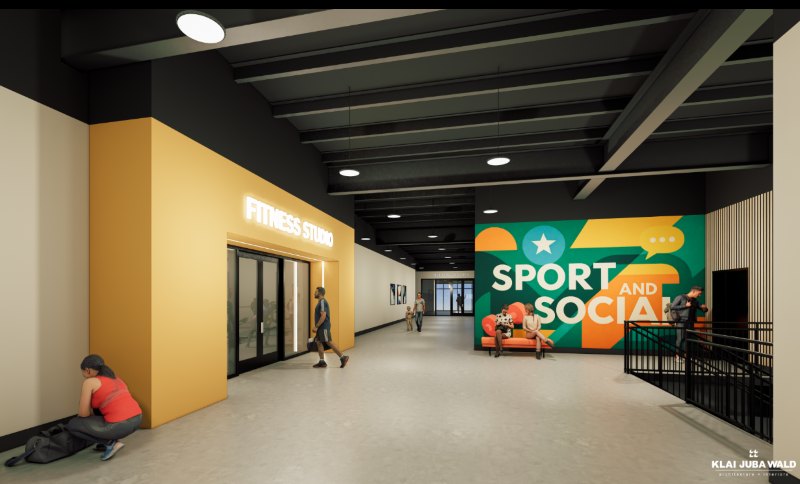
Henderson Sport & Social (Henderson, Nev.) — Opening Oct. 16, this 180,000-square-foot, $70-million complex is a little different in that it’s a public-private partnership between the City of Henderson and operator KemperSports. The city-owned, KemperSports-operated venue is being built primarily as a community recreation asset with four convertible basketball courts, 20 bowling lanes, laser tag, mini-golf, two turf fields, a 30,000-square-foot family entertainment zone. But it also explicitly carves out “dedicated community and event spaces” and takes corporate-event inquiries — an example of how even publicly funded rec facilities are now building event/meeting capacity into the blueprint from day one rather than adding it later as an afterthought.
Puttshack — This tech-infused mini-golf chain now is marketing itself directly to corporate buyers, with dedicated “corporate event space” messaging across markets. Its Boston location can host up to 500 guests for a full-venue buyout; Philadelphia goes up to 690. The company’s marketing explicitly positions itself as an alternative to “another icebreaker” or “awkward gift exchange,” aiming squarely at HR and office-manager buyers planning happy hours, holiday parties and team outings — and offering full-venue buyouts as a standard product, not a one-off.
Chicken N Pickle — Built around pickleball courts plus a chef-driven restaurant and bars, this Kansas City-founded chain (which also has a location in Henderson, Nev.) has leaned hard into meetings-and-events as a core business line. Its venues list dedicated meeting rooms by name and capacity — some accommodating groups of 20 to 1,000+ — with AV access, private bars and direct sightlines to the courts so a meeting can transition straight into a team activity without changing venues.
SPIN and similar competitive-socializing concepts — Ping-pong-anchored venues marketing to corporate buyers use almost identical language to Puttshack and Chicken N Pickle: Interactive activities accessible across skill levels, layouts that encourage mixing rather than fixed seating, F&B built into the experience rather than treated as separate catering, and onsite event staff so planners aren’t managing logistics during the event.
Traditional venues are adapting, too. Purpose-built corporate event venues like Pike & West in Germantown, Tenn., are redesigning to accommodate this same idea of providing spaces that flex between structured programming and organic networking, with an eye toward atmosphere and flexibility rather than pure capacity.
Know Before You Book
A few tips to make using eatertainment venues more seamless:

- Source the venue the same way you would source a hotel or conference center. Especially the first time you book one, an eatertainment venue may feel like a quirky novelty add-on to a program. But these venues increasingly have dedicated sales teams, events kits and named function spaces with stated capacities, so RFP them the same as you would any other venue. Also, don’t assume you can book one as a last-minute add-on. As these gain in popularity, these venues are booking out faster than they used to. Pricing also may be getting more competitive as multiple chains, including Puttshack, Chicken N Pickle and SPIN expand into similar mid-size and growth markets.
- “Private event space” doesn’t always mean a full buyout. Many of these venues are open to the public with no membership required, so it’s important to confirm whether you’re getting a semi-private zone within a live public floor or a true exclusive buyout. Also, ensure that the space is priced accordingly: Buyout capacity varies enormously by property (500 guests at one Puttshack location, 690 at another, for example).
- Ask about acoustics and AV. If your agenda includes actual content—a keynote, breakout sessions or a formal presentation—confirm the meeting space is acoustically and physically separated from the activity floor, not just placed in a corner of it.
- Check to ensure all skill levels will feel included. The stronger eatertainment operators are explicit about designing for mixed-ability participation so competitive activities don’t let a few strong performers dominate and sideline everyone else, but that may not be the case everywhere. Be sure to ask during a site visit or call, especially for large, mixed-seniority groups.
You May Also Be Interested In…
Corporate Retreats That Don’t Feel Corporate
When Transportation Becomes the Main Attraction
Where to Take Your Team: The Top Retreat Destinations
Image from Magnific.com