
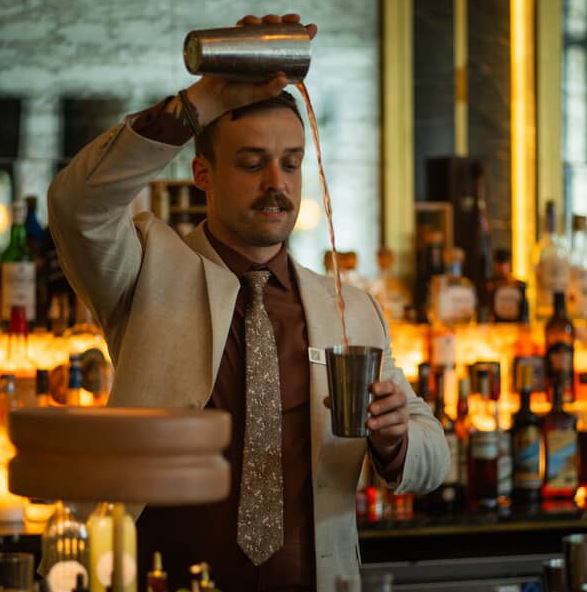
Gavin Miller on mindful mixology, and why what’s in your glass has always been about more than taste
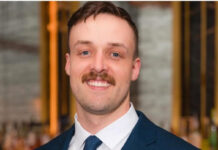
The phrase “mindful drinking” tends to conjure images of kombucha-sipping wellness influencers and sparkling water with a fancy garnish. But spend 10 minutes with Gavin Miller, Beverage Director at Fairmont Chateau Lake Louise, and you’ll come away with an entirely different picture. Mindful mixology, as Miller sees it, is more a rediscovery than a new trend. The idea that what we drink should nourish comfort, or heal is, he argues, the original premise of the cocktail. The craft bar movement, the sober-curious wave, the explosion of adaptogenic ingredients and alcohol-free spirits — all of it, in his view, is a homecoming.
That homecoming is increasingly well-documented by industry data. The no- and low-alcohol beverage sector grew by 7% globally in 2023, outpacing the overall drinks market, and consumer research consistently points to health and wellness as the primary driver. Nearly half of sober-curious consumers say they are shifting their habits to improve their health. Mixologists and bar directors are responding: Sophisticated zero-proof cocktails, adaptogenic bitters and low-ABV menus are not just a concession to guests who don’t drink alcohol; they are a centerpiece of ambitious beverage programs. At Chateau Lake Louise, set within Banff National Park and drawing an increasingly wellness-minded luxury traveler, that shift is essential.
But Miller’s approach goes somewhere most beverage directors don’t: Back into history, and forward into science, to make the case that the line between a cocktail and a tonic was never really a line at all.
The Apothecary at the Bar
“When I got here and we were opening The BASIN Glacial Waters wellness facility,” Miller recalls, “the first question was: What does a beverage program for a wellness space even look like? And my first instinct — matcha, green tea, make it feel healthy — I quickly realized was completely surface level.” He spent a few days sitting with the question and found himself returning to his roots as a bartender doing deep research on the ingredients he used every day, going back to the very beginnings of humans and alcohol.
The ingredients that define classic cocktails — bitters, vermouths, Italian amaros and aperitivos — were not invented for flavor or a pleasant drinking experience. They were medicine. The apothecaries of the 17th, 18th and 19th centuries were infusing the medicinal properties of aromatic herbs and roots into alcohol because alcohol was the most reliable preservative available. It kept the essential oils of medicinal botanicals stable and potent on a shelf for years, Miller explains. The flavor profiles we now celebrate — the complex bitterness of an amaro, the herbal depth of a vermouth — were, originally, the taste of treatment.
Miller’s favorite illustration of this is Peychaud’s Bitters, a staple of the Sazerac cocktail and one of the defining flavors of New Orleans. Antoine Amédée Peychaud was a Creole apothecary who emigrated from Haiti and opened a pharmacy on Royal Street in the French Quarter in the early 19th century. The bitters recipe he developed — rooted in gentian, anise and a closely guarded blend of botanicals — was a medicinal tonic he served to patrons, reportedly including his fellow Freemasons after their meetings, mixed with cognac and sugar as a vehicle for easier ingestion. His old pharmacy on Royal Street still stands in the French Quarter, and the nearby New Orleans Pharmacy Museum — housed in the building of Louis Dufilho Jr., the first licensed pharmacist in the United States — dedicates much of its collection to exactly this history: The bottles, preparations and herbal remedies that formed the original vocabulary of what we now call cocktails. “This person was giving out a Sazerac as medicine,” Miller says with a laugh. “Not ‘here’s a cool cocktail.’ It was, ‘Drink this — it will help you.’”
Angostura Bitters — the other great pillar of classic cocktail making, essential to an Old Fashioned — has a similarly medical origin. It was created in 1824 by Johann Siegert, a German army surgeon stationed in Venezuela, as a stimulant tonic for troops suffering from malaria and fatigue. The gin and tonic, now one of the world’s most-ordered drinks, began as a practical solution to the same problem: British soldiers in colonial India were required to consume quinine to ward off malaria, and mixed it with gin, sugar and lime to make the bitter medicine palatable. The lime was itself a scurvy preventative — hence the gin gimlet, which used lime cordial to deliver vitamin C on long sea voyages at a time when fresh water was not trusted aboard ships the way alcohol was.
“Mixology as a concept started with apothecaries,” Miller says. “When we research the products we use every day — bitters, amaros, vermouths — what we find, every single time, is that they were rooted not just in wellness but in literal medicine of the time. The bar wasn’t separate from the pharmacy. In many cases, it was the pharmacy.”
Ancient Techniques, Modern Science
Grounding the beverage program in this history is, for Miller, more than an intellectual exercise. It is the foundation for a genuinely sophisticated non-alcoholic offering — one that goes considerably further than swapping out spirits for juice.
The key, he explains, is that the logic of herbal infusion long predates European apothecaries. Asian and Arabic cultures had developed extraordinarily nuanced systems of infusing medicinal properties of botanicals into water — teas, in the broadest sense — centuries before alcohol-based preservation became common in the West. Where alcohol infusions are relatively forgiving (pack your herbs in high-proof spirit and leave them; the alcohol does the work), water-based infusions demand precision. Temperature, time and the order of introduction all matter enormously, and vary by botanical. Steep cardamom too hot or too long and you get an aggressive, perfumy note; find the right lower temperature and longer infusion and you unlock a softer, fatty, floral quality that reads almost like a different ingredient altogether.
“The most complicated part is the old part,” Miller says. “Dialing in a water infusion — how you get the low-end floral note of cardamom without the high-end perfumy shout — is trial and error that never really ends. It’s time-consuming. But it’s also the most interesting.” The newer techniques are, by comparison, more tractable: Redistillation, de-alcoholization, the use of hydrosols and glycerins and modern binding agents to combine oils and water-soluble compounds that would normally refuse to coexist in the same glass. What would otherwise be a heterogeneous separation of flavor components becomes a stable, layered, complex liquid — the structural equivalent of a well-built cocktail, without a drop of alcohol, he explains.
The result is a non-alcoholic menu built on the same ethos as the rest of the program: locality, depth and an invitation to experience something genuinely new. Miller works with a small number of suppliers who share a similar philosophy — including a nod to Seedlip, the pioneering non-alcoholic spirit brand whose distilled botanical blends helped shift industry perception of what zero-proof could taste like, while developing several base ingredients in-house using these combined ancient and modern techniques.
“We use the very old approach with temperatures and herbs and time frames,” he explains, “and then we use a very modern approach with redistilling and binding to create what would otherwise be impossible — oils in water, stable and expressive. It sounds more complicated than it is. Honestly, it sounds a little bit insane. But it amounts to a real blend of 1,000-year-old tea infusion techniques and modern food science, and the results are something I’m proud of.”
Wellness at Altitude
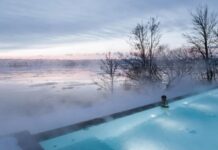
All of this thinking finds its fullest expression at The BASIN, the hotel’s wellness facility. At altitude, dehydration is a real concern — particularly for guests moving in and out of saunas and steam rooms — and the physiological effects of alcohol are amplified. The beverage program here is built almost entirely around non-alcoholic hydration and restoration, anchored by a curated tea ritual that takes the ancient infusion philosophy and gives it a contemporary hospitality frame.
Guests at The BASIN can take one of five wellness “trails” that maps their experience — the sequence of pools, saunas and experiences — and staff recommend teas matched to that journey, from energizing blends to calming, warming infusions. The tea menu is built on the same principles Miller has applied to his non-alcoholic cocktail development: Deliberate, temperature-controlled infusion of botanicals selected for both flavor and effect. It is, in the most literal sense, a modern apothecary.
Alcoholic options exist at The Basin — a champagne program and three signature cocktails, each referencing a regional Fairmont property — but they are the sideshow. “I’m proud that the tea program we’ve built there is sophisticated enough to carry the experience on its own,” Miller says. “You don’t need alcohol to have a meaningful, layered, considered beverage experience. That was true 400 years ago, and it’s true now.”
It’s a philosophy that lands with particular force in the context of a national park resort where many guests — and meeting attendees — are spending multiple days on-property, often alternating between corporate programming, outdoor adventure, spa time and dining. The beverage program needs to serve every version of that guest, at every point in their day. Mindful mixology, in this sense, is the backbone of a program designed to meet people exactly where they are, Miller says.
A Movement Whose Moment Has Come
The broader industry is clearly moving in the same direction. The no- and low-alcohol category is one of the fastest-growing segments in hospitality, with a consumer base that is younger, more health-aware and more willing to pay a premium for complexity and craft than previous generations. Movements like Dry January have shifted the cultural framing of not drinking from absence to intention, and dedicated events like the Mindful Drinking Festival in the United States are attracting audiences that would have seemed inconceivable a decade ago. Bars at prestigious hotels around the world are developing dedicated zero-proof menus that rival their alcoholic counterparts in creativity, price and ambition.
Miller welcomes all of it, but is clear that the excitement for him is not trend-driven. It is rooted in the same historical curiosity that led him down the apothecary rabbit hole in the first place. “When you research this stuff, you realize that we’re not inventing something new,” he says. “We’re remembering something old. The apothecary and the bartender were the same person. The tonic and the cocktail were the same drink. We separated them somewhere along the way. We’re now putting them back together.”
For meeting and incentive planners considering Chateau Lake Louise as a host hotel, that synthesis has a practical dimension too. A group that includes non-drinkers, wellness-focused attendees, or simply people who want to pace themselves across a multi-day stay will find a beverage program built to serve all of them with equal seriousness. Nobody is handed a sparkling water and left to get on with it. The same craft, the same storytelling, the same sense of place that goes into a signature cocktail at Fairview Bar goes into the non-alcoholic menu at The BASIN.
In that, Gavin Miller may be doing something more significant than building a great beverage program. He may be modeling what hospitality’s relationship with alcohol as an expansion of what the bar can mean.
You May Also Be Interested In…
Banff and Lake Louise Redefine Incentives
Waste Not, Want Not: Avoiding Food Waste at Events
F&B Trends: A Feast for the Senses