
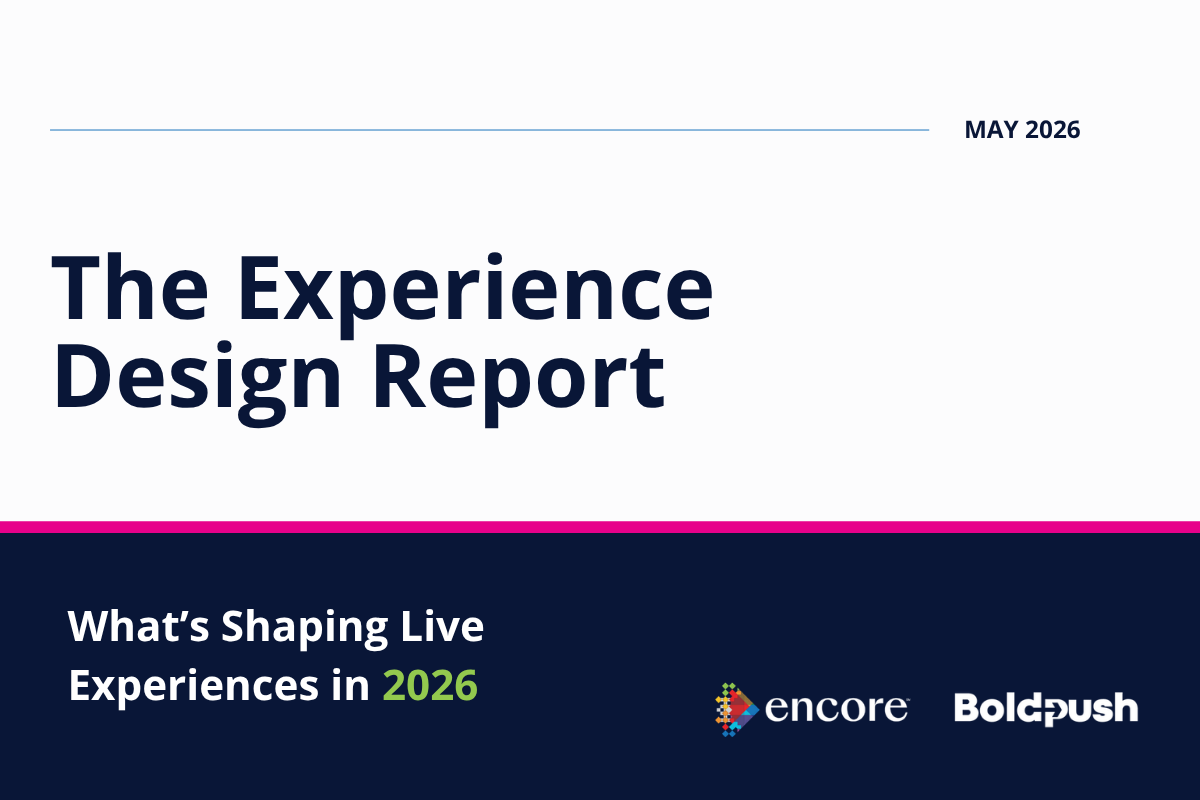
A new experience design report from Encore and Boldpush finds that while event planners know what attendees want, they all too often don’t deliver it. We asked Encore’s VP of Customer Experience and Insights why the gap persists — and what it takes to close it.
New data from Encore and industry research firm Boldpush surfaces a strange paradox. In The Experience Design Report: What’s Shaping Live Experiences in 2026, a survey of 447 event professionals, 49% of planners identified attendee-to-attendee connection as the single most important factor in event success — yet just 8% build structured programming around it.

Prevue recently sat down with Jill Hunt, Encore’s Vice President of Customer Experience and Insights, to unpack why that gap exists, what’s changing in format and technology, and how planners can start designing for the outcomes they say matter most.
On the Connection Gap
The data shows 49% of planners say peer networking is the #1 priority, yet only 8% build structured programming around it. What do you think is actually stopping planners from acting on what they know matters most — is it budget, habit, or something else?
Hunt: One of the biggest hurdles is that it’s tough to understand people’s needs in advance. Pairing attendees can feel like a high-stakes exercise — if you miss the mark, it can feel forced or even counterproductive. Technology can help surface commonalities, but it’s only as strong as the inputs. The key is asking the right questions upfront — what attendees want to learn, who they want to meet — so you’re creating a clear path to connection, not just a match.
Giving attendees choice in how they engage, and involving them in the process, helps make networking feel more intentional. Ultimately, it’s about building micro-communities that extend beyond the event, and while it may not be perfect at first, it will only improve as technology evolves.
16% of planners still leave networking entirely to chance. What does “structured connection programming” actually look like in practice for a planner who’s starting from scratch?
Hunt: First, connection doesn’t start when attendees walk into the room, it starts before they arrive. The most effective events are using data and AI to match people around shared professional and personal interests, then bringing those connections to life through curated small-group moments onsite and offsite using clear prompts, roles and outcomes so attendees aren’t left to do the work of connecting on their own. Then sustaining those relationships after the event so it’s a designed journey, not a one point-in-time interaction.
On Format and Programming
Roundtables lead satisfaction overall, but panels take over at 10,000+ attendees. What is it about large events that makes panels more effective, and how should planners who run events at multiple sizes think about this?
Hunt: At scale, larger audiences need clarity and efficiency. Panels allow planners to deliver diverse perspectives that are digestible for hundreds to thousands of people at once, whereas smaller formats like roundtables are more effective when intimacy and direct participation are the goal. Both play a role, no matter what the size of your event and your objectives. Plus, offering peer-led or discussion groups at large meetings will add ROI because it helps attendees connect more easily.
Microevents boost registration, but 25% of planners don’t offer them. What are the most common reasons planners skip them, and what’s the minimum viable version a planner could test?
Hunt: Microevents can feel complex because planners assume they need to build something entirely new every time, especially across large programs. In reality, the simplest starting point is carving out small-group breakouts within an existing agenda. While there’s no standard definition of a microevent, this could mean a curated sponsored dinner, hands-on workshop, pop up product activations or a behind-the-scenes tour or VIP experience. This is an area where we’re seeing a lot of growth and excitement.
On Technology
Mobile apps lead on connection ROI, but you note they may simply be “winning by default” as the most widely used tool. How confident are you that mobile apps are actually driving connection versus just being credited for it?
Hunt: Technology alone doesn’t create connection — it enhances and amplifies it. Mobile apps are effective because they’re everywhere, but without intentional design that is paired with programming behind how people engage, they’re just a passive tool. The impact comes from how they’re used to guide interaction and bring people together.
35% of planners say AI is already changing why people attend in-person events — but 35% also say they’ve observed no change. What accounts for that split, and which group do you think is reading the market correctly?
Hunt: We believe this boils down to adoption. Companies actively experimenting with AI from captioning to summaries to translations, are potentially seeing shifts in attendee engagement. At the same time, others haven’t operationalized it yet, so the impact isn’t visible. We expect adoption of digital and AI-enabled technologies to grow, and it’s an area Encore continues to invest in to enhance attendee engagement, expand accessibility, and turn data into personalized, authentic co-created experiences.
Our latest AI-solutions include Speaker Spotlight Bumpers, which provide visually engaging, professional introductions immediately before a speaker takes the stage and help audiences connect more quickly with presenters and Cinematic Brand Intro Videos that showcase a brand’s story or recent achievements through a streamlined, high-impact format.
On Venues and Production
You found that involving production partners at the concept stage correlates with more innovative formats. Can you give a concrete example of what that earlier collaboration looks like, and how a planner makes the case internally to bring partners in sooner?
Hunt: The most impactful events bring production partners in at the concept phase not just to execute, but to co-create, aligning on audience goals, flow and environment early so technology, space and content work together rather than being layered on later. This allows for more creativity, predictability and potentially less strain on your budget since you’re managing unexpected costs. Too often we see this disconnect when agencies assume they will keep control of the creative, or when hotels assume discussing production or AV costs too early will be a deterrent. But bringing all parties to the table early will benefit everyone and make your event stronger.
Budget, infrastructure and logistics are the top three barriers to using non-traditional venues — yet only 3.4% of planners say they see no value in them. What’s the most practical first step for a planner who wants to experiment without taking on major risk?
Hunt: The planners who are most successful in non-traditional venues aren’t retrofitting. They’re designing the experience with those constraints in mind from day one.
We recommend embracing what makes that venue unique, lean into that concept and imagine how an offsite evening experience or immersive session can provide a different environment that compliments the full program.
Non-traditional venues unlock more memorable experiences, but they weren’t designed for events, so production has to be part of the conversation from the beginning. It requires a more integrated approach between design, technology, and production.
You May Also Be Interested In…
Sensory-Driven Event Design: Five Top Tips
5 Trends Shaping Meetings in 2026